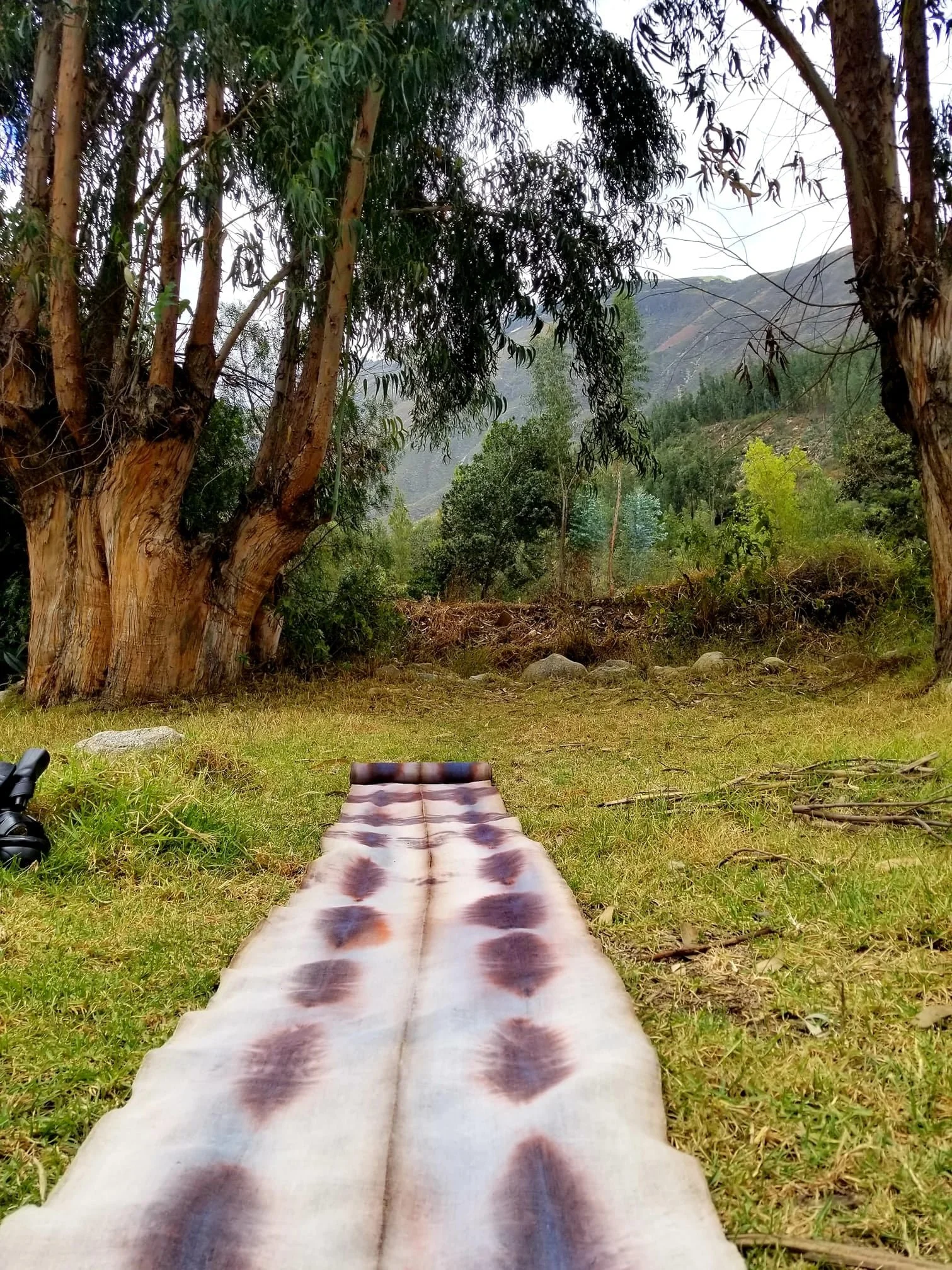
SCROLLS: Durational Visual Landscapes
These scroll works function as durational visual landscapes that unfold through score, movement, memory, and accumulation. Extending from twenty to fifty feet in length, they exceed the scale of a single glance, inviting movement between detail and overview, proximity and distance. Like landscapes, maps, spectrograms, and ecological systems, they reveal themselves through sequence rather than immediate comprehension. Meaning emerges through travel—of the body, the eye, and memory itself.

Constructed through repeated acts of looking, marking, and revising, the works register changing states of attention across extended periods of time. Built through patterned variation rather than fixed composition, they accumulate shifting relationships across fields of mark, interval, density, and repetition. The works are less concerned with depicting a world than with creating conditions through which changing relationships become visible.

The paper scrolls accumulate through successive acts of inscription, notation, and response. The woven scrolls accumulate through the physical construction of the field itself. One records duration on the surface; the other embeds duration within structure. Though materially distinct, both operate through extended processes of accretion, allowing time to become legible through repetition, variation, and sustained attention.

Each scroll functions simultaneously as notation, score, and record of action. Developed in collaboration with the improvisational multi-instrumentalist Solomon Kimrey, the works establish structures through which drawing and sound evolve together. Marks establish intervals, rhythms, densities, and points of orientation that become frameworks for improvisation and exchange. Drawing and sound continually extend and reinterpret one another.

The scroll format is central to this inquiry. Unlike framed images, which present themselves all at once, scrolls preserve continuity while revealing themselves gradually. They resist instantaneous viewing. Viewers encounter only portions at any given moment and must construct understanding through movement, memory, and return. At close range, details emerge while the larger field disappears. At a distance, broader structures become visible while individual marks dissolve. Neither perspective is complete. Understanding develops through continual movement between scales.

Rather than depicting landscapes, these works behave like landscapes. They must be traversed. They invite close looking, distant looking, and looking across. Like ecological systems, topographic surveys, satellite imagery, or moving through terrain, they reveal different forms of knowledge at different scales. The closer one moves, the more complexity appears. The further one steps back, the more detail is compressed. There is no final vantage point from which the work can be fully possessed.

The works emerge from a sustained fascination with accumulation, scale, and the ways complex systems reveal themselves gradually through attention and duration. They acknowledge that most systems—ecological, material, social, and imaginative—are larger and more complex than any single moment of observation can contain. They invite prolonged looking not in pursuit of mastery, but in recognition that understanding remains partial and unfolding.

The scroll becomes a structure for travel: unfolded, traversed, remembered, and encountered in portions rather than possessed all at once. Every view is partial. Understanding emerges through accumulation rather than mastery.