ARRANGEMENTS
These photographs are field notes from a practice of observation, recording what emerges when materials are placed into relationship and given time.
The studio follows me. It appears wherever paper, fiber, tools, books, plants, light, weather, and found objects gather into temporary arrangements. A room, a garden, a gallery, a lakeshore, or a table can all become places of work. Much of the practice begins by moving materials into proximity and paying attention to what happens next. Similar patterns emerge across radically different scales. Cloth resembles terrain. Soap resembles stone. Mica becomes an archipelago. A sheet of paper recalls a river delta. The boundaries between studio and world remain deliberately porous, allowing light, insects, weather, and time to participate in the work.
Taken together, these images document an ongoing effort to understand materials through relationship rather than isolation.

Yarrow grown, harvested, cooked, and beaten by hand for papermaking. Transformation often requires passing through forms that no longer resemble either beginning or end.

Mushroom broth reflecting a studio window. Cooking, gardening, weaving, photography, and writing all begin with the same practice: paying attention long enough for ordinary things to reveal themselves.

Practices move through us much the way light moves through a window. We inherit ways of seeing, making, tending, and noticing from the people, materials, and environments around us. The boundary between inner and outer life is more permeable than it appears.

Mica resting on handmade paper reflects the studio window back into the room. The photograph rewards delayed recognition. What first appears simple gradually reveals layers of repetition, reflection, and relationship.

Moths resting on a mirror. The image lingers because it resists easy separation. Body and reflection, interior and exterior, observation and participation remain briefly entangled.

Walnut ink on handmade cotton paper. The squares began as a meditation on repetition. The arrival of a single insect transformed the surface into a landscape.

Three balls of hand-spun yarn photographed from ground level. The image makes them appear monumental, which feels appropriate. Few technologies have done more to clothe, shelter, and sustain human life, yet spinning is so often treated as something small.

Two cloud studies cut from paper more than twenty-five years ago. I continue to return to them as examples of reduction—how a form can become more itself as information is removed.

Hand-spun Himalayan nettle. Long valued for its strength and durability, the fiber carries a quality I can only describe as trustworthiness. The hand recognizes it immediately.

A moth resting on a mirror. Its silhouette briefly evokes military aircraft, revealing an uncomfortable continuity between organism and machine. The same forms that allow creatures to move efficiently through the world often reappear in technologies of surveillance, control, and war.

I keep sheets of mica throughout the studio and place them upon cloth, paper, drawings, and found objects. These temporary arrangements are a way of thinking through relationships. New work often begins by watching materials reveal unexpected affinities.

Handmade soaps containing botanicals and exfoliants from the garden. Seen from this vantage, the bars resemble a landscape more than a household object. Soapmaking remains one of the studio's recurring practices—a space where repetition becomes a vehicle for experimentation. Each batch carries a different combination of plants, oils, scents, textures, and observations.

Collage on handmade paper combining a Kabuki performer and a female figure. I am interested in the moment when unrelated images suddenly appear to belong to one another. New meanings often emerge not from the images themselves, but from the relationships formed between them.

Cloud study on handmade paper created entirely from thumbprints. The image interests me because it allows the scale of the body and the scale of the landscape to briefly collapse into one another.

Torn handmade paper dyed through the slow melting of ice containing concentrated pigments. The resulting forms record the movement of water, gravity, absorption, and time.

Hand-spun linen dyed with walnut and indigo. Folded upon the studio floor, the textile begins to resemble an aerial landscape. I am continually struck by how similar patterns emerge across radically different scales, linking cloth to weather, geology, water, and terrain.

study of handwoven cloth drawn on handmade paper. The drawing records the textile, but the deckled edge quietly joins the composition, echoing the fringe and transforming the paper from support into participant.

Honey and marigold soaps stacked into temporary structures. The arrangement began as an experiment in light, but quickly became an exercise in perception. The bars resemble amber, stained glass, or geological formations, revealing qualities that remain hidden in ordinary use.

Natural dye and ink on handmade paper. The repeated squares began as a meditation on rhythm and variation. Then a mother spider carrying her young entered the composition. Moments like this remind me that the studio does not end at the edge of the work. The larger world is always participating.

Sheets of mica resting on dark hand-dyed cloth. Their translucent surfaces catch and redirect light, transforming the textile into something resembling an archipelago. I often arrange materials in temporary constellations, allowing unexpected relationships and associations to emerge through observation.
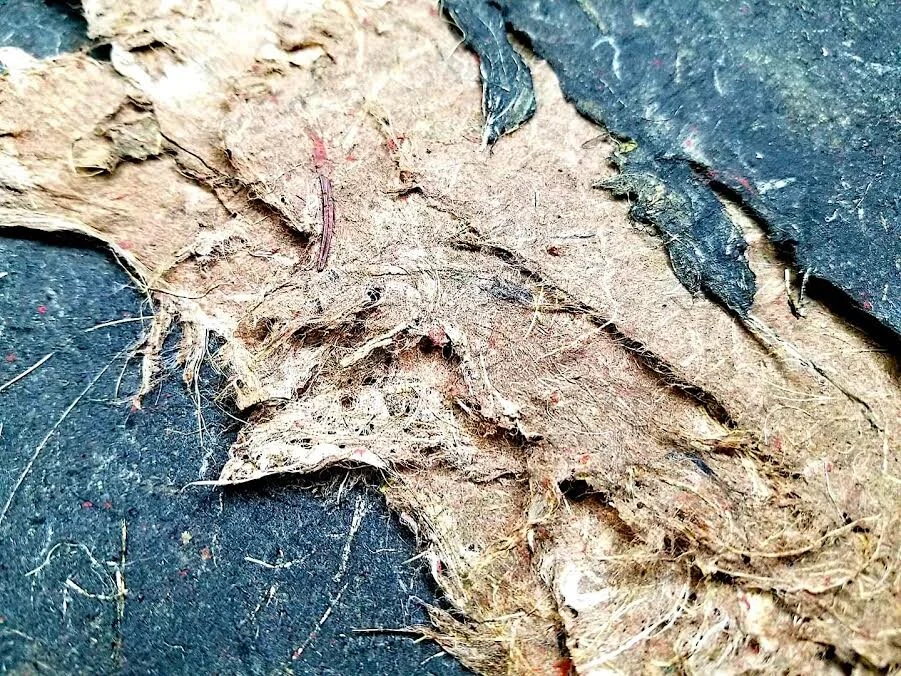
Handmade paper made from hand-beaten yarrow stalks I cultivated and harvested, combined with kozo fiber. The sheet retains the memory of both plants, allowing their structures to remain legible within the paper. Its torn fibers suggest coastlines, tributaries, and eroded landscapes, echoing a recurring theme throughout the studio: the unexpected reappearance of terrain within the smallest materials.
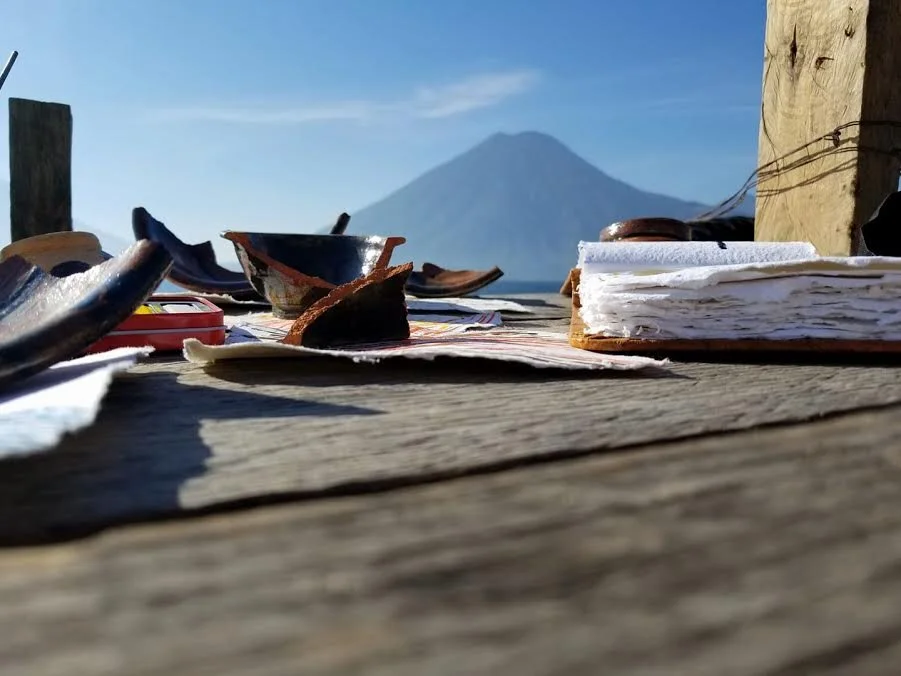
Temporary outdoor studio, Lake Atitlán, Guatemala. Handmade paper is weighted with fragments of broken pottery to keep it from lifting in the wind. What interests me is the way materials repeatedly shift roles. A vessel becomes a weight. A pier becomes a landscape. A shoreline becomes a studio. Much of my practice involves arranging environments in which unexpected relationships can emerge and reveal themselves through sustained observation.
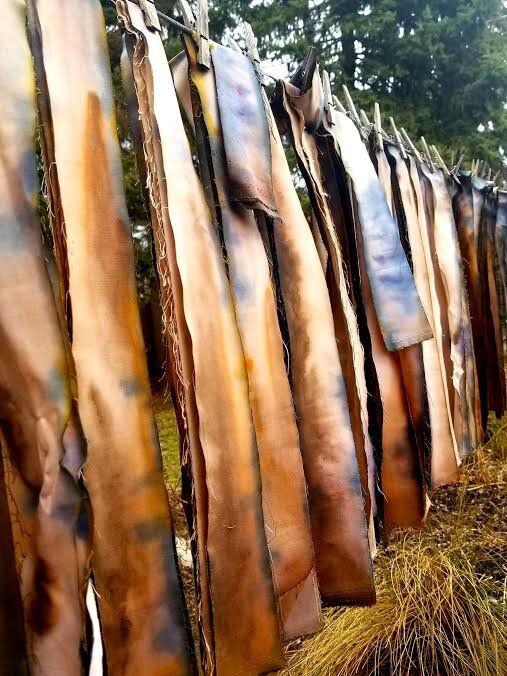
The studio follows me. It appears wherever materials, tools, light, and attention gather into relationship. A room, a garden, a gallery, a lakeshore, or a table can all become sites of inquiry. Much of my practice begins not with making, but with arranging conditions in which observation, experimentation, and unexpected affinities can emerge.